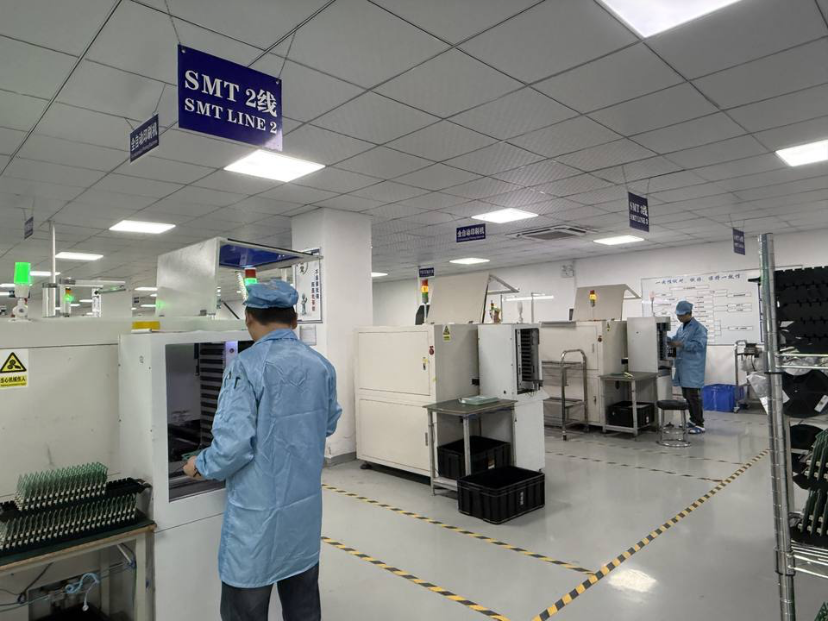
PCB assembly costs per board often fall as order quantity rises because some expenses belong to the job rather than to each board. Preparing a stencil, configuring equipment, and establishing a test setup can require work whether a batch contains ten assemblies or a hundred. A small order spreads those charges across fewer finished units.
That does not mean buying more boards always saves money. Additional inventory must be considered alongside the lower quoted unit price. For hardware teams funding prototypes and early customer orders, the useful comparison includes total cash committed, usable boards, leftover components, and the cost of another design revision.
Contents
- Separate job costs from per-board costs
- Calculate what a quantity increase actually changes
- Distinguish component consumption from purchasing cash
- Check which charges return on repeat orders
- Price the inventory risk before ordering more
- Request a cost summary that supports a decision
- Frequently asked questions
Separate job costs from per-board costs
Start by grouping the quotation into three categories. Job-level charges can include tooling, equipment preparation, or initial test development. Recurring costs include the agreed materials and manufacturing work for each board. Separately billed items can include component overages, packaging services, storage, and shipping. The supplier should explain where each charge belongs.
Some costs do not fit a perfectly fixed or variable category. Assembly time can change with batch size, while a fixture may serve several orders before needing maintenance or replacement. Ask for the assumptions behind the breakdown instead of treating every “setup” line as a permanent one-time purchase.
For a first build, teams requesting OrinewPCB’s prototype PCB assembly service can ask for job-level charges and recurring manufacturing charges to be shown separately. This makes the prototype budget easier to interpret without assuming that the same unit price will apply to later production.
Calculate what a quantity increase actually changes
A simplified model makes the effect of setup costs visible:
Manufacturing subtotal = job-level charge + quantity × recurring cost per board.
Average manufacturing cost per board = manufacturing subtotal ÷ quantity.
Assume a $300 job-level charge and a recurring manufacturing cost of $14 per board. The figures below are hypothetical teaching examples, not OrinewPCB prices or a customer case. The model holds the design and recurring rate constant and excludes separately purchased excess components, freight, and taxes.
| Quantity | Job charge | Subtotal | Per board |
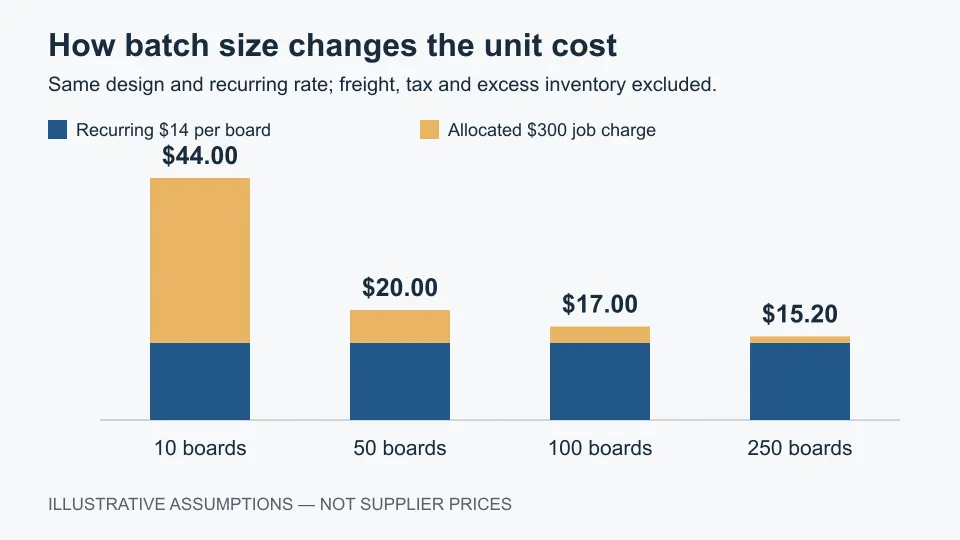
| 10 | $300 | $440 | $44.00 |
| 50 | $300 | $1,000 | $20.00 |
| 100 | $300 | $1,700 | $17.00 |
| 250 | $300 | $3,800 | $15.20 |
Illustrative calculation only. A $300 job charge is divided across more boards; the assumed $14 recurring cost does not change.
The reduction from $20 to $17 per board looks attractive, but moving from 50 to 100 boards also commits another $700. If only 50 boards are needed before the next design review, the lower average price is not automatically the better purchase.
Real quotations can differ from this model. Component price breaks, panel utilization, setup arrangements, and assembly rates can change at different quantities. Request actual prices at two or three realistic quantities and ask what changes between them. Do not extrapolate a supplier’s entire price curve from one quotation.
Distinguish component consumption from purchasing cash
A bill of materials can describe the parts consumed by a board without describing the cash needed to acquire them. Packaging choices, minimum purchases, order multiples, and agreed setup allowances can increase the quantity purchased beyond the quantity fitted.
Full reels are not universally required for small orders. Texas Instruments lists full reel, custom reel, cut tape, and tube or tray options; its custom-reel service also carries a reeling fee. DigiKey explains that smaller quantities may be supplied in cut tape or repackaged forms. Check the options available for the actual part and the assembler’s handling needs before assuming that a full reel is unavoidable.
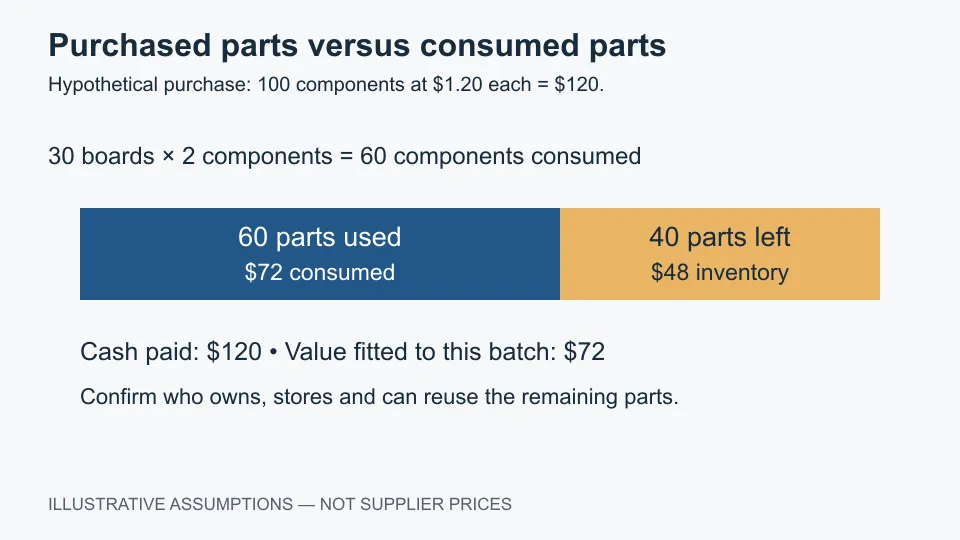
Consider another hypothetical example. Thirty boards need two identical components each, so the build consumes 60 pieces. If the agreed purchasing arrangement requires buying 100 pieces at $1.20 each, the component payment is $120. Of that amount, $72 goes into the boards and $48 remains in 40 unused pieces, before any additional allowances.
Hypothetical material purchase. Unused parts can remain an asset; their ownership and future usability determine their value.
Ask whether those remaining parts belong to your company, whether they can be returned or transferred, and whether a later order receives credit for them. Avoid paying for the same inventory twice. Leftovers are not automatically waste, but a planned redesign or an uncertain repeat order may make their future value limited.
Check which charges return on repeat orders
A repeat order can avoid some initial spending without eliminating all preparation. A retained stencil or a usable test fixture may support another run. Equipment still needs to be scheduled and configured, and the supplier may charge for that work even when the design is unchanged.
Ask for two estimates: the first order and an unchanged repeat at the same quantity. Each should identify retained tooling, fresh setup work, component inventory carried forward, and charges triggered by changes. Clarify ownership and storage terms for paid tooling rather than assuming that “tooling included” means it can be transferred elsewhere.
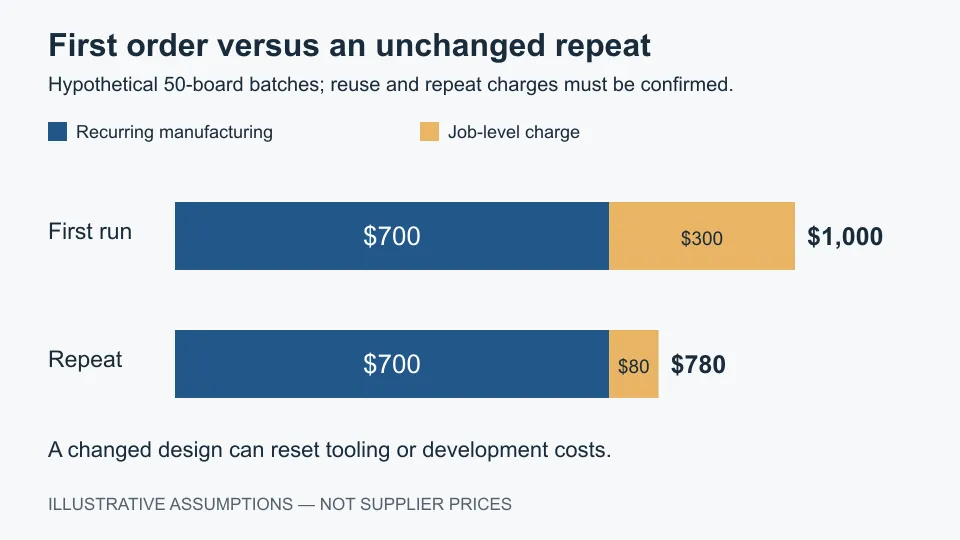
Illustrative scenario, not a savings promise. A confirmed lower repeat-job charge reduces the total from $1,000 to $780 for 50 boards.
In the illustrated scenario, the recurring subtotal remains $700, while the confirmed job charge falls from $300 to $80. A design revision could invalidate that assumption by requiring a new stencil, changed tooling, or revised test development. Obtain the repeat price against defined conditions, not a general assurance that future orders will be cheaper.
Price the inventory risk before ordering more
Separate “cost per board ordered” from “cost per board likely to be used.” If 100 boards cost $1,700 but a revision makes half unusable, the manufacturing spend works out to $34 per usable board. That is higher than the $20 average in the hypothetical 50-board order, even though the larger order initially looked cheaper.
This is a scenario calculation, not a forecast of failure or obsolescence. Its purpose is to test the purchasing decision against a plausible design change. Discuss how many boards are needed for confirmed deliveries, internal validation, and justified spares before accepting a quantity discount.
For uncertain demand, ask whether staged manufacturing or scheduled releases are available. Confirm which costs are committed immediately, which materials are purchased in advance, and whether another release creates another setup charge. A split shipment alone does not necessarily reduce the inventory obligation.
Request a cost summary that supports a decision
A useful summary answers five commercial questions: what is payable now, how many usable assemblies it covers, which assets remain afterward, what another unchanged batch would cost, and what a design revision would reset. Keep the comparison focused on those answers rather than the lowest displayed unit price.
Teams evaluating low-volume PCB assembly services can request quantity breaks, first-order versus repeat-order charges, and the treatment of leftover components in one quotation. Use the resulting figures to choose the smallest batch that meets the next real demand or validation milestone at an acceptable total cost.
Cost reduction should come from an appropriate batch size and clear purchasing arrangements. Removing inspection, accepting unapproved substitutions, or buying surplus boards simply to improve a unit-price figure changes the product or the risk rather than demonstrating a genuine saving.
Frequently asked questions
Why can ten assembled boards cost much more per unit than a hundred?
Job-level preparation is divided across fewer boards. Component price breaks and handling arrangements can also affect the difference. Ask for a breakdown to identify which factors actually apply to the quoted design.
Does a small assembly order always require full component reels?
No. Cut tape, custom reels, and other packaging options may be available. The answer depends on the part, seller, quantities, and the assembler’s process requirements.
Are setup charges always paid only once?
No. Some paid assets may be reused, while run preparation, revised tooling, or changed test development can create additional charges. The quotation should distinguish reusable assets from work performed for each order.
Is ordering more boards the most effective way to reduce cost?
Only when the additional boards are likely to be useful and the total commitment fits the project. Compare the cash outlay, surplus material, design stability, and repeat-order terms alongside the quoted price per board.
