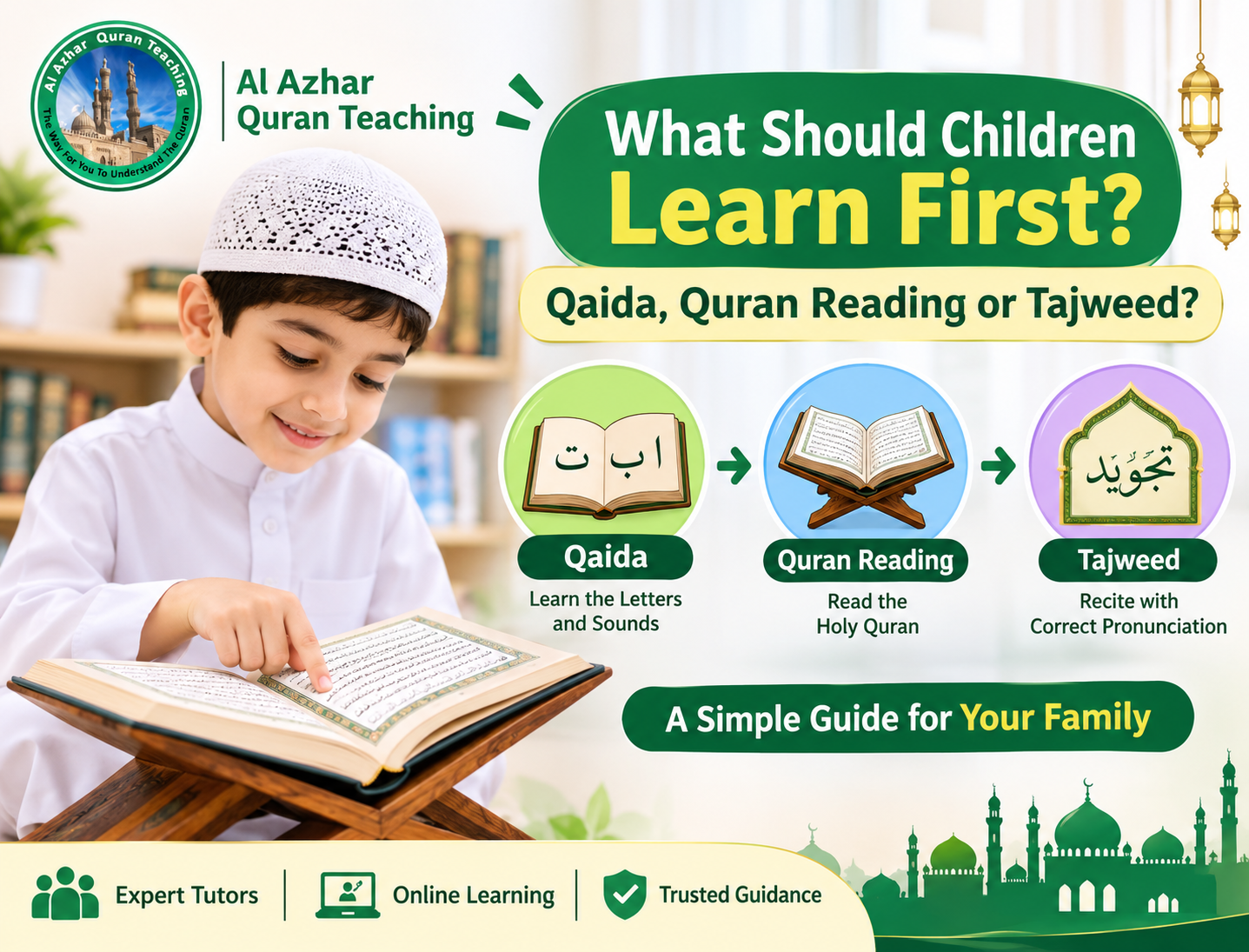
Few questions divide Muslim parents as quickly as the one about where a child’s Quran journey should begin. Some say jump straight into surahs, while others insist on perfect pronunciation before a single verse is read. If you are working out how to start teaching Quran to kids at home, the answer is a sequence, and the order matters more than speed.
This guide explains what each stage involves, how to tell when a child is ready to move on, and which mistakes slow families down.
The Short Answer
Start with Qaida, move into guided reading, and introduce Tajweed gently from the first week of reading. The three are stages that overlap, and each one rests on the one before it:
- Qaida gives the child the letters, sounds and vowel marks.
- Beginner Quran reading puts those skills to work on real verses.
- Tajweed refines how each sound is produced and connected.
A child who skips the first stage tends to guess at letters. A child who delays Tajweed too long often has to unlearn careless habits. Teaching both in the right proportions avoids each problem.
What Qaida Teaches
Quran Qaida for children is the foundation course. The Arabic script has 28 letters, and most of them change shape depending on whether they appear at the start, middle or end of a word. A child who cannot tell these shapes apart will guess, and guessing becomes a habit that is hard to break later.
A solid Qaida course covers:
- the 28 letters, with their names and sounds
- short vowels (fatha, kasra and damma) and long vowels
- sukoon, shaddah and tanween
- joining letters to form simple words
Parents who need a refresher can read our guide to the Arabic letters and alphabet before sitting down with their child. Many teachers also use the Iqra method, a graded reader that moves from single letters to full words in small steps.
Readiness matters more than age. A common rule of thumb puts a young child’s focused attention at two to three minutes per year of age, so a five-year-old may manage ten to fifteen minutes. Lessons should be sized to that limit. Many children start Qaida at four or five, and starting later causes no harm.
When to Move From Qaida to Reading
Timelines vary a great deal, but several months of regular practice is typical for Qaida. Instead of watching the calendar, look for these signs:
- The child reads vowelled words without spelling out each letter.
- Similar sounds, such as seen and saad, are told apart reliably.
- Long and short vowels are held for the right length.
- The child can repeat a word after the teacher with the same sound.
At this point beginner Quran reading can start with short surahs the child may already hear at home or in prayer. The first surahs most children meet are short enough to read in one sitting, which builds confidence quickly. Reading alongside a teacher is better than reading alone, because a mistake repeated ten times at home takes weeks to fix.
Where Tajweed Fits
Tajweed comes from a root meaning to make something excellent. In recitation, it means giving every letter its proper sound, length and connection. Many parents assume it belongs at the end of the journey, after the child already reads fluently. In practice, light Tajweed belongs from the beginning, because the way a child first pronounces a letter is the way it will likely be pronounced for years.
Tajweed for kids works best as listening and repeating, with theory kept small. A sensible order looks like this:
- The articulation points of each letter, meaning where in the mouth and throat it is produced
- Madd, the stretching of long vowels
- The noon sakinah rules, which govern how a silent noon and tanween are pronounced
- Ghunnah and qalqalah, once the basics are secure
One rule at a time is enough. Memorizing definitions before a child can hear the difference rarely sticks. Structured Tajweed classes designed for children keep the rules tied to recitation instead of turning them into a vocabulary test.
Parents can also take comfort from a well-known hadith reported in Sahih al-Bukhari and Sahih Muslim. It says the person who recites skillfully will be with the noble angels, and the person who struggles through it earns a double reward. Progress is slow for most children, and effort counts.
A Simple First-Year Roadmap
For a child taking two or three lessons a week, a realistic plan might look like this:
- Months one to four: Qaida, covering letters, vowels and simple words
- Months four to eight: short surahs read with the teacher, plus the first lessons on where letters are pronounced
- Months eight to twelve: longer passages, madd and noon sakinah, with weekly revision of earlier surahs
Treat this as a rough guide. A child who finds a stage hard should stay in it longer, and a quick learner can be stretched with slightly longer passages. Accurate reading is the best measure of progress, and the number of pages finished says very little.
Facts and Trends Worth Knowing
- The Quran has 114 surahs divided into 30 parts, so a clear plan helps a young learner see the road ahead.
- Pew Research Center estimated about 1.9 billion Muslims worldwide in 2020. In many places, qualified teachers are hard to find within travel distance.
- Live one-to-one video lessons have become a common route for families without a local teacher.
- Shorter sessions of 20 to 30 minutes, audio recordings for practice and parents sitting in during early lessons are now standard in many programs.
Common Challenges
Most delays come from a handful of avoidable problems:
- Rushing into surahs before the letters are secure
- Practicing only on lesson days, with no daily revision
- Long sessions that exhaust a young child’s attention
- Constant correction that makes the child afraid to read aloud
- Comparing children in the same house, which is a particular problem for families managing siblings at different levels
Practical Tips for Parents
- Ten minutes of daily revision beats one long weekend session.
- Record the child reciting and play it back, so they hear their own mistakes.
- Praise effort first, then correct one thing at a time.
- Ask any teacher about their training, and book a trial lesson before committing. Look for verifiable credentials such as an ijazah.
- Sit in on the first few weeks so you know what to reinforce at home.
- Consider live online Quran classes for kids if no suitable teacher lives nearby, since one-to-one attention lets the pace match the child.
Frequently Asked Questions (FAQs)
1. At what age should a child start Quran Qaida for children?
Many children begin Qaida at four or five, but readiness matters more than age. A child who can sit for ten to fifteen minutes, recognize shapes and copy sounds is usually ready. Starting later causes no harm. Parents can find a gentle starting point in these beginner-friendly Quran lessons.
2. Can Tajweed for kids start before Qaida is finished?
Light Tajweed can start early, as long as it stays practical. Teachers usually correct how a letter is pronounced from the first lessons, then add formal rules once the child reads vowelled words steadily. The science of Tajweed explains what each rule is for.
3. How long does it take to move from Qaida to beginner Quran reading?
Several months of regular practice is typical, but the pace depends on age, lesson frequency and daily revision. Ten focused minutes at home each day helps more than one long weekend session. This guide to how to read the Quran with Tajweed shows what comes next.
4. How can parents support Tajweed practice at home?
Keep sessions short and work on one rule at a time. Record your child reciting and play it back so they can hear the difference themselves. Praise effort before correcting. A basic look at how letter sounds are produced also helps parents follow the teacher’s corrections.
5. Are online lessons effective for teaching Quran to kids?
They can be, when lessons are live, one-to-one and matched to the child’s level. Look for certified online tutors, ask about their training and book a trial lesson first. Al Azhar Quran Teaching offers online lessons for children at every stage, from Qaida onward.
6. Should children learn Arabic alongside Qaida?
Basic Arabic helps, since it gives the child a feel for the sounds they are reading. It does not need to be a separate course at the start. Short vocabulary and letter games alongside lessons are enough, and these reasons for teaching Arabic to children can guide how much to add.
7. How do parents in Western countries keep children motivated?
Consistency and a fixed time each day matter most, since school and screens compete for attention. Short lessons, small rewards for milestones and a calm, encouraging tone work better than pressure. This advice on raising a child in the West covers the wider picture.
8. When should a child begin memorizing surahs?
Memorization works best once the child reads accurately and can repeat words with correct pronunciation. Starting too early often fixes mistakes in memory. Many families begin with short surahs and revise them weekly, and these memorization methods explain how to keep them from fading.
See also: Sun-Powered Agriculture: How Solar Technology Is Making Farms More Sustainable
Conclusion
Qaida first, guided reading second and Tajweed woven in from the start is the order that works for most children. It protects them from guessing, builds confidence early and gives pronunciation a chance to settle before habits harden. Every child moves at a different pace, so the stage matters less than a steady routine and a patient teacher.
Al Azhar Quran Teaching has taught Quran, Tajweed and Arabic online for around ten years, and a trial lesson is a practical way to see which stage suits your child today.
